Technology
in Service of Emotion
Oladra technology defers to listening.
Science informs, yet feeling resolves.
This principle has guided our craft for decades.
Why the Source Matters
Timing first finds form at the source. It is what allows music to arrive as performance, rather than assembly.
If unsettled at this stage, nothing downstream can restore it.
Many designs begin as general-purpose computers
- systems built to shift and adapt under multi-tasked load.
Such movement denies the conditions timing depends on.
Music requires a more intentional foundation.
The Oladra Platform
The Oladra Platform emerged in stages.
Its foundations were first expressed in the original Oladra — a statement of immersive listening intent.
The Platform tips digital audio design on its head,
focusing on how the Core first generates the signal, rather than on downstream attempts to repair things after the event.
Downstream techniques can refine the signal,
but cannot undo the electrical environment established by the Core, within which the DAC must operate.
The Platform is articulated through distinct domains,
each addressing a specific form of disturbance. not as remediation, but as prevention.
The Core is the processing heart of the source.
It gathers the static certainty of stored music
and the irregular arrival of streamed data. Both are settled into memory before releasing them onward in time.
Testing layouts and elements revealed that we must design the Core for its purpose, not merely select and adapt it.
This moment proved to be decisive. Where the magic of music is preserved or diminished.
Here, processing power must exist without agitation. Timing must be asserted without force.
Data must move without disturbance.
The Core determines the conditions under which every domain that follows must operate.
Instability introduced at this stage cannot be undone later - only managed.
The Core is not the beginning of sound. It is the beginning of order.
The motherboard is the terrain from Core to signal connection, across which every signal must travel.
Designing this terrain places signal transmission under our direct high-end audio discipline and intent.
We shape each input and output into the form we want. Then we guide it deliberately and with precise definition.
Consistency matters here. Not all signals demand the same precision,
but all respond to balance, symmetry, and restraint.
What we have learned is that calm transmission is preferable to speed achieved in bursts.
General-purpose computers favour abundance: many interfaces, many paths, many possibilities.
Each one complicates routing, introduces activity, and disturbs the Core it is meant to serve.
By limiting what is present, we reduce what must be managed.
Fewer paths allow clearer ones. Less activity allows greater composure in the Core.
The motherboard’s role is not to impress. It is to disappear.
Power and time are inseparable.
Every transition a computer makes is both an electrical event and a temporal one.
The precision of either depends on the stability of both.
We have learned that speed, when properly controlled, can serve definition rather than disrupt it.
A power supply must respond decisively to demand, yet do so without agitation or excess.
This requires discipline. Noise must be filtered before it can combine.
Interactions must be prevented before they arise.
Clocking follows the same truth.
The accuracy of a clock is not determined by an oscillator alone, but by the stillness of the environment in which it operates.
Power integrity, ground stability, and surrounding activity all shape its behaviour in time.
This extends beyond the source itself.
Even within a DAC, the clock does not exist in isolation. Its environment is influenced by what precedes it
- by the composure, timing, and noise character of the Core that feeds it.
Power and clock are not subsystems to be optimised independently. They are conditions to be preserved.
Stillness must be protected from all external influences.
In most enclosures, form is assembled: thin panels bent, joined, and reinforced
to approximate rigidity.
We take a different approach.
Our enclosures begin as solid material, machined so structure is inherent rather than added.
No brackets to resonate. No seams to flex.
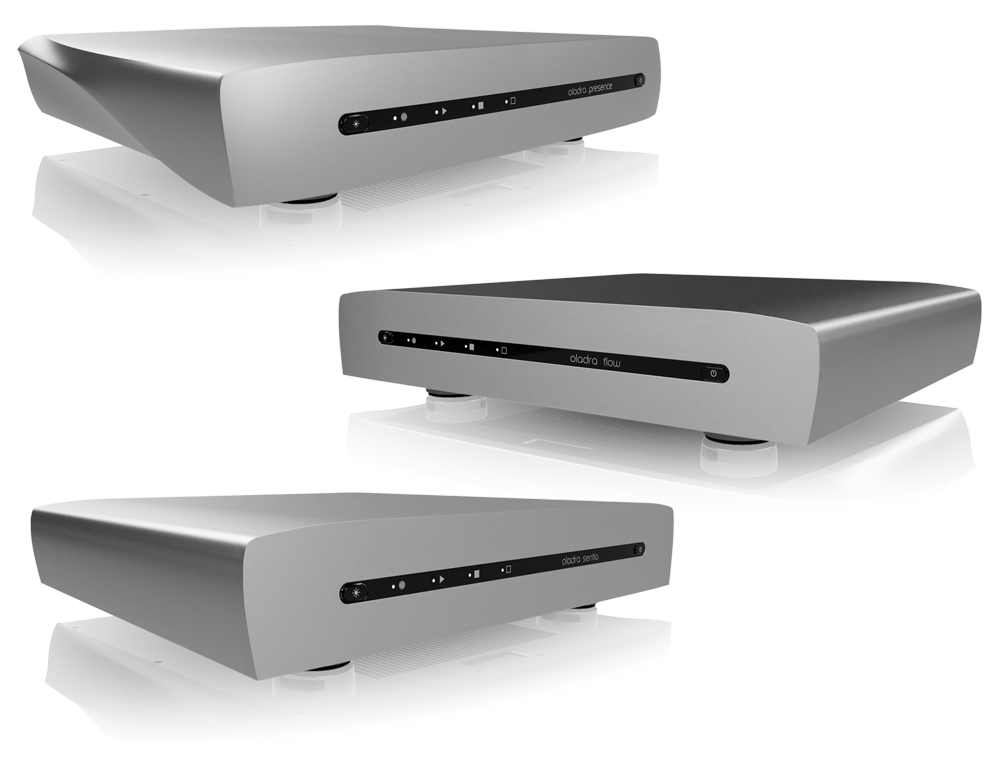
In the Presence, the top, sides, and front are carved from a single block,
reducing interfaces and halving mechanical interaction.
This level of care is only found in the finest equipment racks, where mass and integrity are used
to quiet motion before it can propagate.
The same principle applies here.
Mechanical instability does not remain mechanical.
It translates, subtly but inevitably, into electrical disturbance.
The enclosure is not a container. It is part of the system.
A network is not a neutral conduit.
It is an open system, shared, bursty, and electrically active - carrying influences beyond the data it delivers.
What happens within the network itself is outside our control.
What happens at its boundary is not.
When the signal enters the source, it is treated with the same care as any audio signal.
Isolated from intrusion,
regenerated into a known state, and transmitted onward with precision.
This process depends on restraint as much as technique.
A composed Core is essential to this work. Its stillness determines how effectively external activity is rejected
rather than absorbed.
The network’s role is to deliver content. The source’s role is to ensure it does not deliver disturbance.
Stillness must be designed and contained.
Within the Oladra Platform, software is not a layer added to hardware. It is part of the instrument, orchestrating what happens within it.
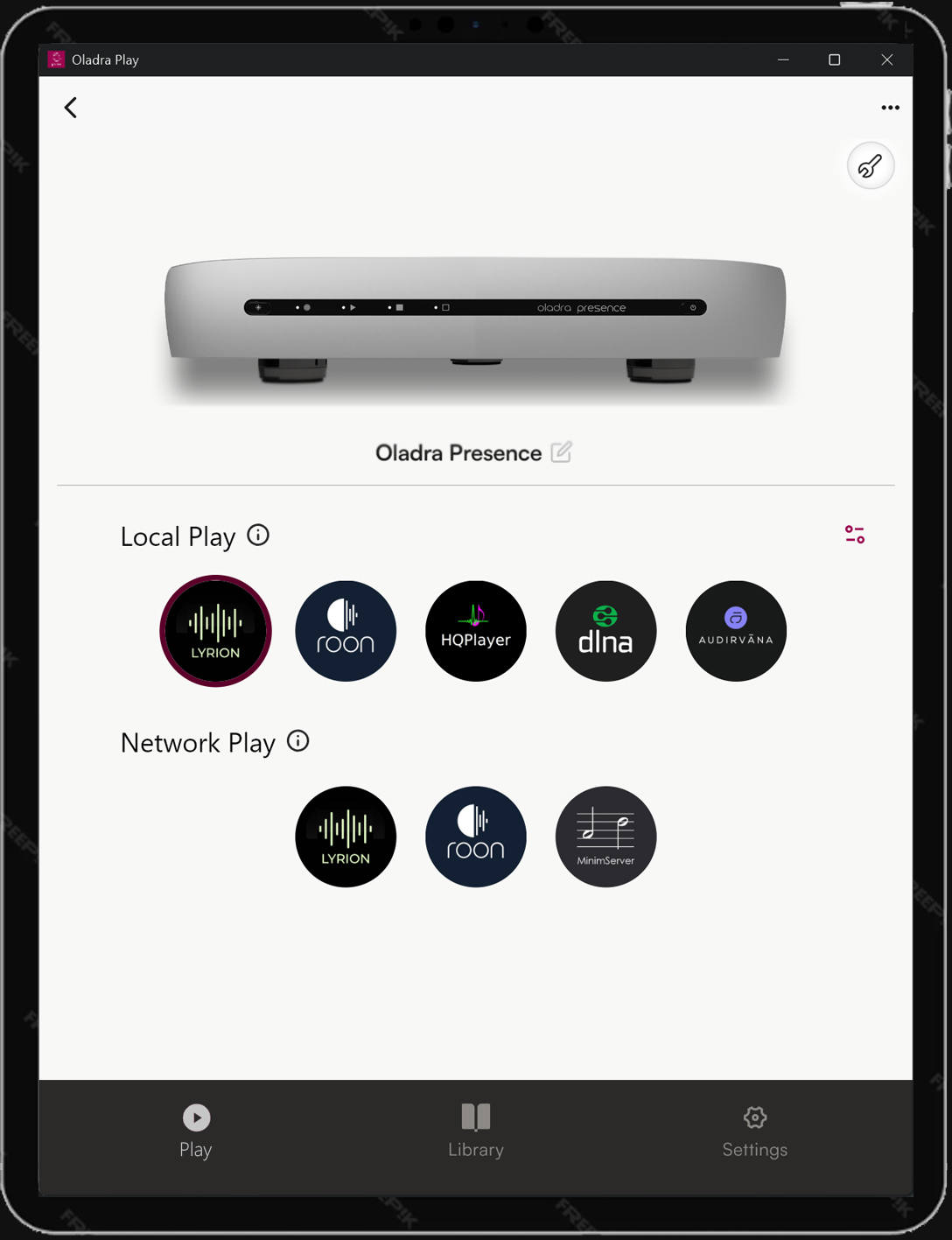
Oladra Play exists as the client: clear, responsive, and complete
- handling interaction, orchestration, and management away from the source itself.
Oladra Node resides on the DAS: a purpose-built software stack,
from operating system upward, dedicated solely to the act of playing music.
By separating control from execution, complexity is displaced rather than suppressed.
Node performs only what it is instructed to perform, when it is instructed to perform it.
This discipline is musical.
Every process, every schedule, every interaction shapes how the system behaves in time.
For this reason, hardware and software are designed together, as one system,
heard as one performance.
Every layer of Node is refined for musical engagement. Every aspect of Play is shaped
to feel intuitive, immediate, and effortless.
When behaviour is intentional, the system becomes quiet.
The Platform's outputs are not fixed endpoints. They are modular elements of the whole,
allowing each system to be configured for the needs of the listener and the character of the DAC.
Only what is required is present. Nothing more.
This restraint serves two purposes: it allows each output to be optimised without compromise,
and it allows change without disruption.
At this boundary, the signal is isolated, re-established in a known state,
and driven onward with precision, using stable oscillation and carefully chosen line drivers.
Each output is designed in full accordance with the established specifications of its interface.
Compatibility is therefore not negotiated, nor approximated,
but assured, provided the receiving device adheres to the same standard.
It might be tempting to believe that adding regeneration stages
would bring the signal closer to perfection.
We have learned the opposite.
Each additional stage introduces its own activity, its own noise,
its own paths for interaction.
These effects accumulate.
For this reason, the Platform is designed for the best start, and the fewest necessary transitions,
executed to the highest possible standard.
Where formats or operating modes extend beyond formal specification, they are approached with care,
supported where possible, but never asserted beyond what can be responsibly guaranteed.
In some cases, collaboration allows more.
When a DAC is designed with a specialised input, and its behaviour is known,
the Platform can be adapted precisely to meet it, with a matched handover, designed together,
and therefore assured.
The Core establishes order, which is preserved through the system to the output.
A single, uncompromised output stage prepares the handover. The DAC completes the work in its own domain.
Here, quality matters, not quantity.
By the time the signal reaches the output, the essential work must already be complete, leaving the DAC to address only the artefacts introduced by the final handover itself.
Voicing
Even within a disciplined system, subtle interactions remain.
Voicing guides these interactions through long-form listening and precise adjustment.
It is where measured performance is settled into emotional balance.
Oladra Play
Oladra Play
Oladra Play is the user-facing layer of the Platform. It extends the same restraint into an interface without complexity.
Control remains clear and composed, reflecting the calm, predictable behaviour of the system itself.
The engineering is intricate. What you touch is simple.
Three Expressions Explore The Collection